Cambridge English Regulations
(Last updated January 2026)
These Regulations cover all Cambridge English exams and were updated in January 2026.
You can also access to these regulations through the Cambridge English Support site.
Information about Cambridge English exams and a list of Centres can be found on cambridgeenglish.org. Centres can provide more information.
Cambridge English accepts exam registrations on the basis that schools and candidates are fully aware of the Regulations. Centres may ask candidates (or their parent/guardian or school representatives) for confirmation.
It is the Centre’s responsibility to ensure that all candidates are provided with the current Notice to Candidates and Summary Regulations for Candidates at the time of registration.
Cambridge English reserves the right to modify its Regulations, as required and from time to time.
If any of these regulations and conditions are deemed invalid or unenforceable, that will not affect the validity and enforceability of any remaining regulations and conditions.
Definitions
- Cambridge English: an exam board and part of Cambridge University Press & Assessment. Experts in English language assessment, responsible for creating, distributing, and marking Cambridge English exams.
- Centre: a Cambridge English Authorised Exam Centre. Centres are independent institutions; they are not directly controlled by Cambridge English and Cambridge English is not liable for actions or omissions by Centres. By registering for a Cambridge English exam, schools, and candidates enter a contractual relationship with their Centre.
- Candidate: an individual who has registered with a Centre to take an exam.
General regulations and conditions
1 Registering for an exam
1.1 Cambridge English exams may be taken by an individual of any age, gender, race, nationality, religion, etc. Although they are designed for speakers of other languages, no language restrictions apply.
1.2 Candidates can take exams as often as they wish (but only once per exam administration), subject to the exam dates set by Cambridge English and scheduled by Centres. Candidates can take different exams in the same week, for example, B2 First and C1 Advanced.
1.3 Candidates must take all components of an exam on the dates specified and it is not possible to take some components in one session and the rest in another session.
1.4 Cambridge English exams have no age limits, but the following exams are designed for school-aged learners:
- Pre A1 Starters
- A1 Movers
- A2 Flyers
- A2 Key for Schools
- B1 Preliminary for Schools
- B2 First for Schools
See cambridgeenglish.org under the relevant exams for details.
1.5 Teaching Knowledge Test (TKT) is a modular exam. Candidates can take any combination of the modules, subject to the exam date offered by the Centre.
1.6 Attempts to breach the registration regulations may result in Cambridge English cancelling the entry without any refund of fees and/or the candidate’s result being withheld temporarily during investigation, and permanently if entry regulations have been breached.
1.7 Registrations for the exams are submitted through a Centre. The Centre will give schools or candidates exam details such as the exam dates, registration closing dates, and exam fees.
1.8 Centres charge fees for Cambridge English exams for each registered candidate. Fees may vary depending on local costs.
1.9 Where Cambridge English permits a school to use its branding, this is not authorisation to act on behalf of Cambridge English but only in connection with the licensing of Cambridge English exams and subject to specific approval and regulations regarding such licensing and branding.
1.10 Centres decide which exams they offer on which date. They may refuse a registration if they are not running that exam, or they have already reached their capacity.
1.11 Cambridge English has some arrangements for candidates with access requirements (e.g., extra time or modified papers) and the Centre will apply approved arrangements on the exam day. Enquiries about these arrangements must be made through Centres as soon as possible, to enable them to prepare and to meet the specific deadlines.
1.12 Late registrations (made after the deadlines) may incur an extra fee. Acceptance of late registrations will depend on Cambridge English's policy and the Centre’s policy.
1.13 Registrations can be transferred to another date before the registration deadline and if the Centre is offering an alternative date.
1.14 When a candidate cannot attend the exam, the Centre may make a full or partial refund or register the candidate for a different date. If the Centre considers that the reason given is justified on compassionate/medical grounds, or because the circumstances were outside of the candidate’s control, they may withdraw the candidate. The Centre may ask for supporting evidence such as a medical statement. When an entry is withdrawn, no result will be issued. Candidates should check with their Centre for any refund policies and deadlines.
1.15 Centres in Africa, Asia, and Australasia must record the ID number when a candidate registers for C1 Advanced. This ID number must be entered into Cambridge English’s exam entry system by the deadline.
1.16 The candidate must inform their Centre at the time of registration if they intend to use the exam for immigration purposes and provide the ID number from an ID that the relevant immigration authority will accept. The candidate must present the same ID on the exam day.
1.17 Candidates must check if they have suitable ID and if they do not have suitable ID, they must inform the Centre before registering for an exam. For candidates aged 17 or under without suitable ID, the Centre will provide a Candidate ID form which must be completed before the exam day.
1.18 Administering Cambridge English Qualifications Digital requires access to the internet, a power supply, equipment, etc. that Cambridge English does not own, control, or assume responsibility for. When registering for an exam, the candidate or their parent/guardian understands that Cambridge English will not be responsible or liable, directly or indirectly, for any damage or loss caused or alleged to be caused by or in connection with the use of or reliance on any such access, equipment, or services.
1.19 Cambridge English believes all people should be treated with dignity and respect. For more information, refer to the Cambridge English Safeguarding policy.
2 Photo ID
2.1 Each candidate, unless they are taking Pre A1 Starters, Pre A1 Starters Digital, A1 Movers, A1 Movers Digital, or A2 Flyers, must bring an acceptable photo ID on the exam day. The ID must include a photo, the candidate’s full name and date of birth. The ID must be original and unexpired. Candidates aged 18 or over must use one of the following:
- a passport
- an identity document issued by the government of the country where the exam is held and officially recognised as proof of identity, such as a driving licence or residence permit.
- government-issued National ID issued in an EU or Schengen area country being used in another EU or Schengen area country.
The authenticity of a physical ID may be verified, alongside visual checks, using methods, such as ultraviolet light or ID scanning devices and applications.
Digital ID may be acceptable if it is government-issued and recognised as official proof of identity in the country where the exam is taking place. The Centre must also be able to verify it on and throughout the exam day using the official verification service. Candidates intending to use digital ID must check before the exam day that their Centre can accept and/or verify the ID.
Candidates, regardless of their age, taking the exam in Africa, Asia, or Australasia must not present a foreign ID unless it is a passport.
A candidate intending to take the exam for immigration purposes is responsible for registering with an ID that the relevant immigration authority accepts and for presenting the same ID on the exam day.
Candidates must inform the test centre of any changes to their ID document before the exam day. Candidates who bring a different ID to the one they registered with, may not be allowed to take the exam and may not be eligible for a refund or transfer.
Candidates aged 17 or under must use either an acceptable ID listed above or one of the following:
- school / college physical ID (provided their Centre accepts it as proof of ID)
- Candidate ID form (downloaded from the support site and completed before the exam).
Candidates taking C1 Advanced in Africa, Asia, or Australasia must present the same ID on the exam day as the one used at registration, otherwise the Centre may not allow them to take the exam or Cambridge English may not issue a result, and they may not be eligible for a refund.
2.2 The candidate's ID number will be checked and saved by the Centre on the exam day. That number will be included with the result on the Results Verification Service. Once the ID number has been uploaded, any amendments need to be verified by Cambridge English. If the ID number is incorrect and verification is not possible, Cambridge will remove the ID number.
2.3 If a candidate does not bring their ID on the exam day, the Centre may not allow them to take the exam, or they may not receive a result.
2.4 Verification of identity may also include biometric checks such as finger/thumb printing, reading of biometric data stored on identity documents, and voice identification. Other verification measures may include signature/handwriting comparison, photo/video recording, and other forms of electronic confirmation. Centre staff and, occasionally, Cambridge English representatives verify identity.
2.5 Only the person registered for the exam can take the exam. If Centre staff cannot confidently verify the identity of the candidate, they must not allow the candidate to take the exam. Occasionally, when there are doubts over a candidate’s identity, a candidate may be required to provide further proof of ID either on or after the exam day, such as presenting another ID and/or providing a copy of their ID to their Centre and/or Cambridge English. If Cambridge English is not confident in the identity of the candidate, they will withhold or cancel the result.
3 Electronic items
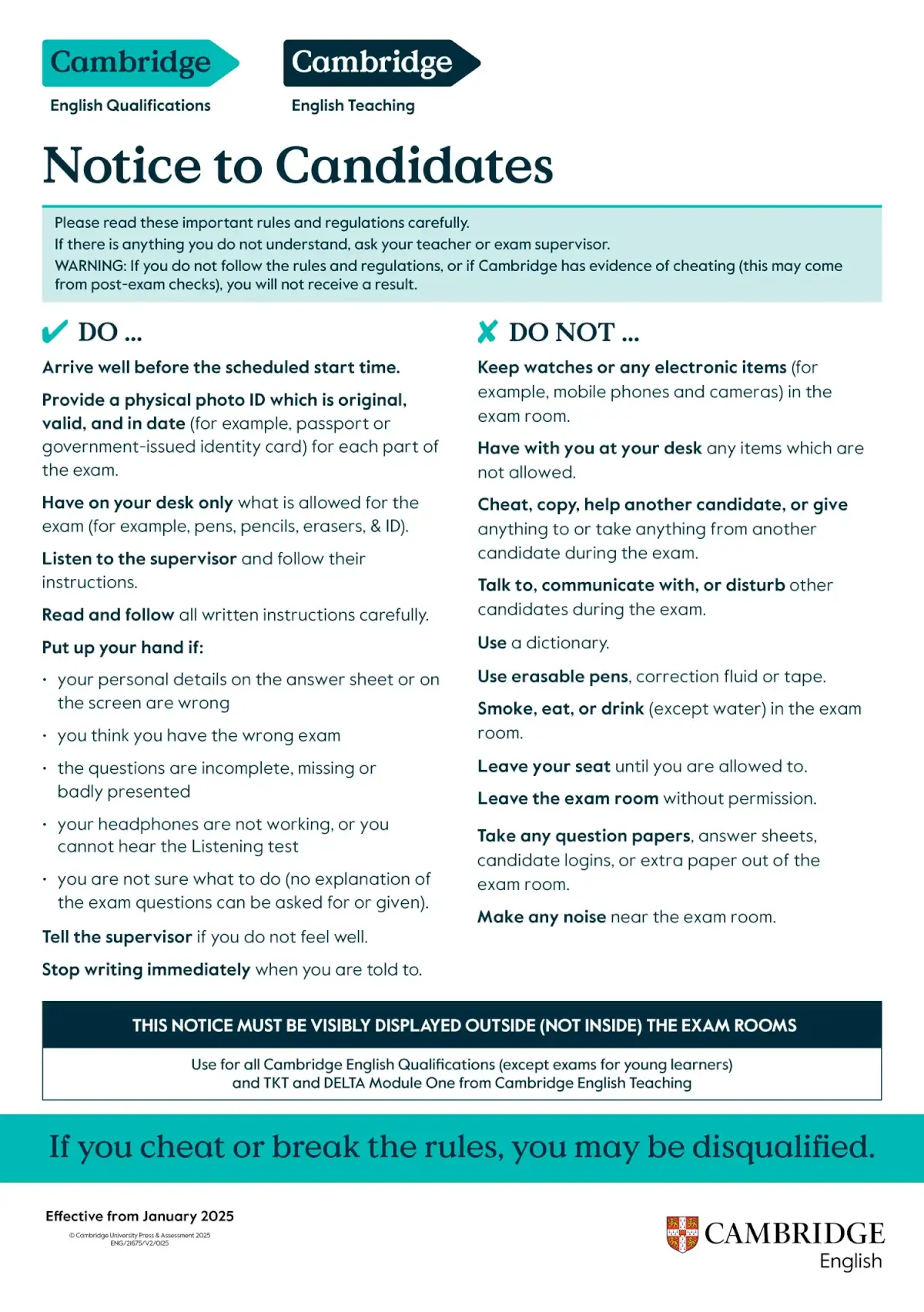
3.1 Candidates must not keep watches (all types) or any electronic items, such as mobile phones, recording devices, audio/video players, etc. in the exam room during the exam. Keeping unauthorised items in the exam room will be considered malpractice.
3.2 Centres or Cambridge English representatives may use electronic detection scanning devices such as hand-held metal detectors/wands.
3.3 Centres must tell candidates before the exam day about the arrangements for electronic items, so that candidates can decide whether to bring these with them.
4 Test day photo
4.1 Test day photos are mandatory for B2 First, C1 Advanced, and C2 Proficiency exams and are one way to check identity on exam day and in the future. By registering for these exams, a candidate, or their parent/guardian, understands that a test day photo will be taken. The list of exams with mandatory test day photo is subject to change and Centres will notify candidates about procedures.
4.2 If a candidate, or their parent/guardian, declines a mandatory test day photo, the candidate may not be allowed to take the exam. In cases where the exam is taken without a photo, Cambridge English reserves the right to withhold or cancel the result. Candidates who decline a photo may find that their options for using the result may be limited because there is no photo on the Results Verification Service .
4.3 The photo, whether mandatory or not, will be added to the Results Verification Service cambridgeenglish.org/verifiers and may be added to the Statement of Results. Candidates decide who can access it via the Results Verification Service by sharing their result via Results Service for Candidates or by sharing their Verification Number with their chosen institution.
4.4 Cambridge English may also use the photo and passport/ID number for malpractice checks.
4.5 If the candidate wants to use their result for immigration purposes, they must remind their Centre when the test day photo is taken. The Centre must check that there is an ID number that will be recorded against the test day photo and that it matches the ID presented by the candidate.
4.6 Cambridge English will not usually issue a result for a C1 Advanced candidate if an acceptable test day photo is not taken and uploaded into the appropriate Cambridge English system. If the candidate’s photo is uploaded after the deadline, their result may be delayed.
4.7 A candidate who would like a test day photo but is taking an exam that does not have a mandatory test day photo must ask their Centre at the time of registration if the Centre can offer a test day photo service.
4.8 Taking photos for any other purpose or filming candidates during an exam is not permitted unless authorised by Cambridge English. Cambridge English sometimes requires the audio and video recording and/or streaming the test day photo process.
5 Taking an exam
5.1 Centres will tell candidates where and when their exam will take place. This may be in a Confirmation of Entry and Timetable which the candidate must check carefully, including name spelling, date, time, and place for the exam. Any incorrect name spelling or other details must be reported to the Centre immediately. Centres may not allow candidates who arrive late to take the exam.
5.2 For security reasons, requests to change the scheduled timetable are not usually approved. If candidates cannot take their exam at the scheduled time, the Centre may ask Cambridge English if it is possible to change the time of the affected exam component(s).
5.3 A Centre must submit a request to Cambridge English to change scheduled timetabling as soon as possible. Cambridge English’s decision will be in writing and is final.
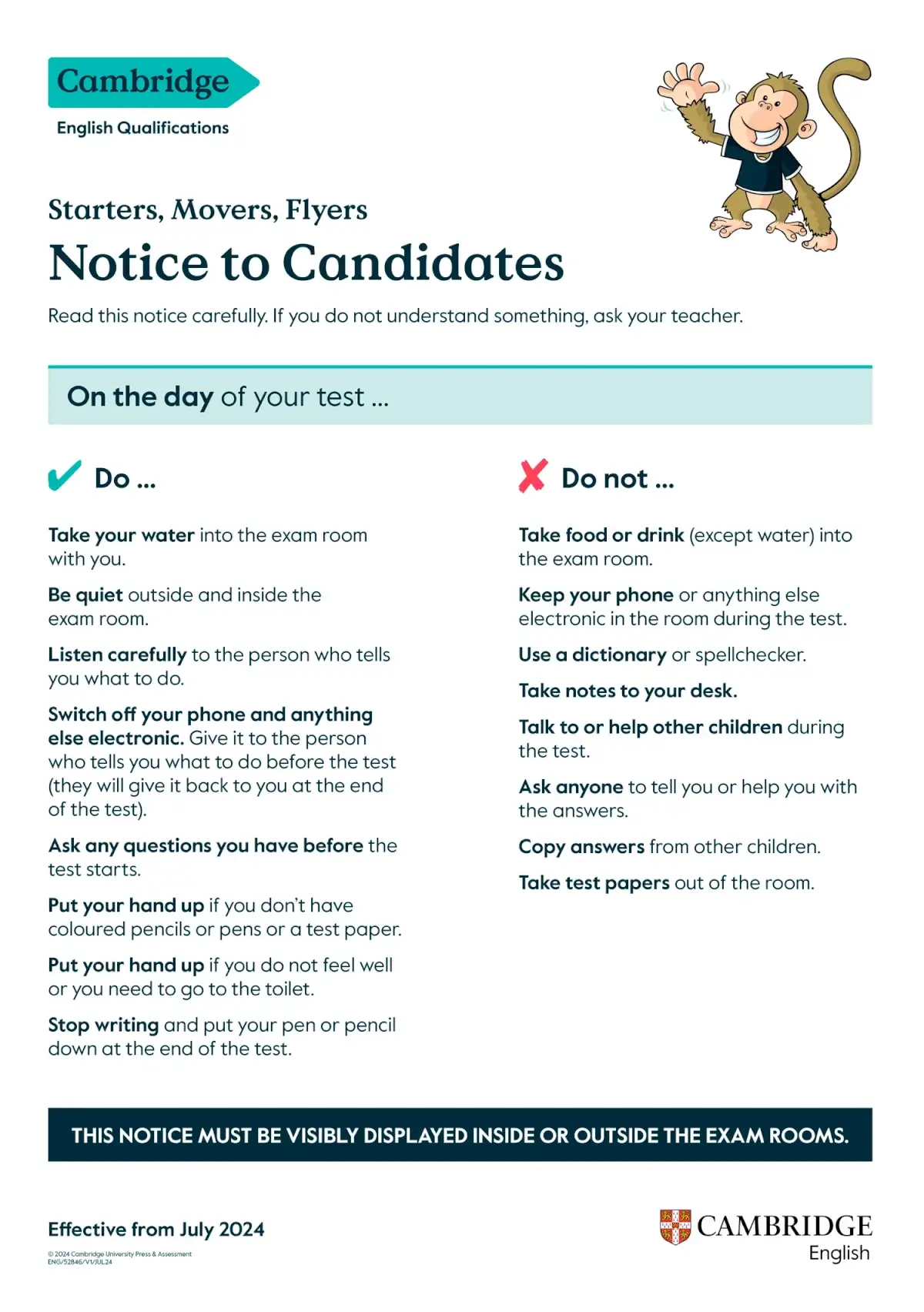
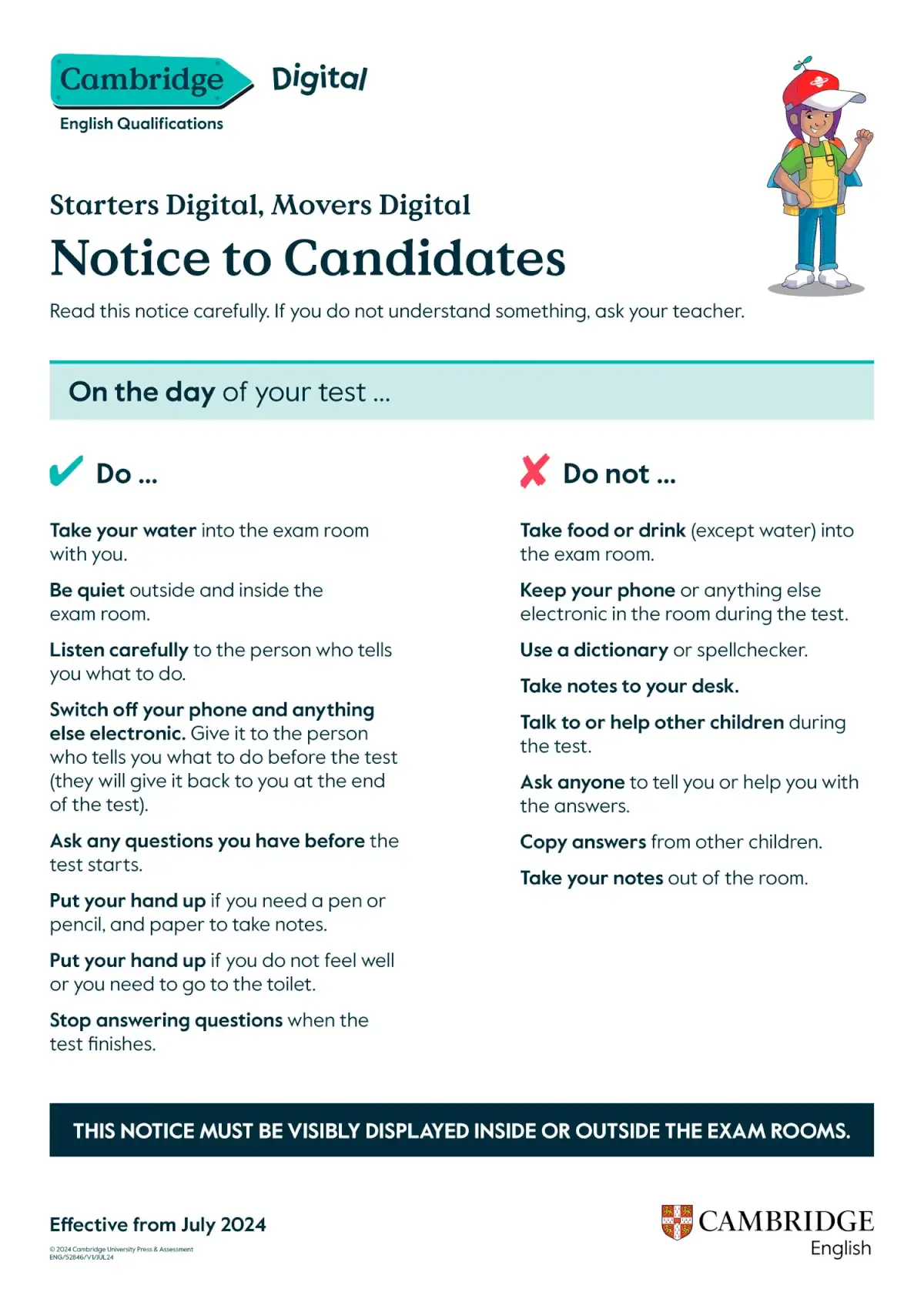
5.4 Key regulations on what candidates can and cannot do during the exam are in the applicable Notice to Candidates. Centres must make this available to each candidate.
5.5 Candidates must be well behaved and respectful while on the premises of the exam venue.
5.6 Cambridge English will not accept offensive language in exam answers and will not mark an exam or give a result if this language is used. The decision by Cambridge English is final.
5.7 Candidates for some exams may be asked basic personal information, such as their country. This is usually done when the candidate registers for their results. This information is used by Cambridge English for research purposes.
5.8 For most exams, Speaking Examiners will use a dedicated app on a mobile device in the exam room to record and upload the test marks.
5.9 The Centre may arrange audio and/or video recording of live Speaking tests for Cambridge English quality, training, and research purposes. Part of the monitoring of Speaking Examiners may involve audio-recording of selected live tests. Candidates will be told by their Centre if their Speaking test is being recorded. An additional Speaking Examiner or Cambridge English representative may be present during a Speaking test to monitor the Speaking Examiners.
5.10 Cambridge English monitors and audits its Centres to ensure that they are administering exams according to its strict regulations and to check quality of service. Centre staff are expected to act respectfully and professionally including with visiting Cambridge English representatives, such as Auditors. Most audits are unannounced and can happen at any exam venue. A Centre may be visited by both an Auditor and a Monitoring Auditor who is observing the Auditor. Auditors may check candidate IDs. Cambridge English may use mystery shopping to check quality of service and/or compliance with regulations.
5.11 Only the supervisor, invigilators, candidates, and authorised Cambridge English representatives are allowed in the exam room. During Speaking tests, only candidates, Speaking Examiners and those authorised to monitor Speaking Examiners are permitted in the exam room. For C1 Advanced, authorised Cambridge English representatives are allowed in the test room.
5.12 Any problem which may affect the performance of a candidate during the exam must be reported to the Centre on the exam day. If supported, the Centre will report it to Cambridge English. Cambridge English will process Special Consideration and where appropriate, adjust the marks of affected candidates to take the circumstances into account. Centres will be informed if Special Consideration is not approved. Cambridge English cannot accept Special Consideration requests after results have been released.
6 Suspected malpractice
6.1 Any candidate not following Cambridge English regulations and the Centre’s instructions, or whose behaviour is disruptive, may not be allowed to take or finish their exam and/or may be subject to Cambridge English Malpractice procedures, as per details on cambridgeenglish.org/help/malpractice.
6.2 Cambridge English values the integrity and reliability of its exams and has strategies, such as statistical analysis, that counter and identify attempted malpractice. The investigation of suspected malpractice cases may delay results.
6.3 Malpractice includes, but is not limited to:
- obtaining unauthorised access to examination material
- attempting to obtain an unfair advantage (cheating or deception) in any way, including using or trying to use unauthorised material
- copying/collusion or attempted copying/collusion, this includes a candidate allowing another candidate to copy their work
- disruptive behaviour
- not following the instructions given by the Centre staff
- keeping prohibited devices in the exam room
- using or attempting to use prohibited devices during an exam
- impersonation (pretending to be someone else)
- reproducing any part of the exam in any medium including memorising test material to gain or give an unfair advantage
- altering any results document, including Statement of Results, in any medium
- accessing the internet or online materials during an exam
- facilitating malpractice on behalf of others
- using, attempting to use, or submitting answers/work produced in whole or part by Artificial Intelligence (AI)
- wearing clothing with useful English words
6.4 Malpractice can be identified and reported by Centres and marking examiners and/or other checks such as statistical analysis.
6.5 Cambridge English representatives, such as Auditors, may ask candidates questions as part of malpractice detection measures.
6.6 Cambridge English reserves the right to withhold or cancel exam results if it determines that Cambridge English regulations may have been breached, or the scores are not a reliable indicator of the candidate's ability.
6.7 Candidates have the right to raise an appeal through their Centre against a decision relating to malpractice. Details of the Cambridge English Appeals Procedures are available on cambridgeenglish.org/help/enquiries-and-appeals.
6.8 Candidates are not entitled to a refund if their results are cancelled or withheld due to suspected malpractice.
6.9 Cambridge English may ban candidates that it determines have been involved in malpractice from taking future Cambridge exams for a period of time as solely determined by Cambridge English.
6.10 Cambridge English may share with institutions, parents/guardians, government agencies, or law enforcement the outcomes of suspected malpractice and/or test security investigations and/or candidates’ names whose results have been cancelled or withheld.
6.11 Cambridge English encourages genuine reports of suspected fraud, malpractice, misconduct, suspicious activity, and threats to the security or integrity of Cambridge English exams. Anyone who believes they have witnessed such incidents should report them to Cambridge English.
7 Results
7.1 Cambridge English cannot be held responsible for the loss of exam materials while at the Centre and its venues or while in transit from the Centre and/or its venues to Cambridge.
7.2 Cambridge English aims to issue results within scheduled timeframes. For most exams, the results will be available from Results Service for Candidates by the scheduled date. Candidates need to register to access this website. The Centre will provide candidates with the registration details, usually in their Confirmation of Entry and Timetable. When the candidate cannot access their results, the Centre will forward the result to the candidate.
7.3 Candidates’ Statement of Results for Cambridge English Qualifications contains the following details: scores within the Cambridge English Scale for each of the four skills, overall score, grade and CEFR (Common European Framework of References) level for the overall exam. Individual exam component performance is not given to those candidates with grade X (absent from part of the exam) and grade Z (absent from all the exam)
7.4 If a school or candidate believes that their result is incorrect, they can through the Centre request an Enquiry on Results for the written exam components via their Centre. The Centre will inform the candidate about the fee and deadlines. Cambridge English exams are either auto marked or marked by Examiners. Examiners undergo intensive training and are monitored regularly. There is no result enquiry process for the Speaking test as this is not recorded as standard; speaking tests are marked by two examiners who have met rigorous quality standards.
7.5 The outcome of an Enquiry on Results may lead to a higher grade, a lower grade, or no grade change.
7.6 If a school or candidate is dissatisfied with the outcome of an Enquiry on Results, they can request an Appeal through their Centre. The Centre will tell the candidate about the fee and deadlines. Full details of the Enquiry on Results and the Appeals procedures are available on cambridgeenglish.org/help/enquiries-and-appeals
7.7 Information about a candidate’s performance in individual exam components is limited to what is contained in the Statement of Results. Cambridge English will give no further information to candidates, schools, or Centres.
7.8 Under no circumstances will Cambridge English return work done by candidates. Statements of Results are continually reviewed and revised to provide the most useful information about candidate performance that can be made available.
7.9 Cambridge English may amend result information under exceptional circumstances. Amendments to the results originally awarded may be made as part of the Enquiry on Results process or due to the need to adjust marks for a particular component following one of Cambridge English post-exam quality check procedures. Cambridge English reserves the right to cancel exam results if it decides the scores for any part of the exam are not valid.
7.10 Cambridge English will withhold or cancel a result if it determines the candidate may have been involved in malpractice and/or has reasonable grounds to suspect that the result is not a reliable indicator of the candidate’s ability.
7.11 Cambridge English reserves the right not to issue results for those candidates where the correct mandatory biometric verification data, such as a test day photo or Speaking test recording, is either of insufficient quality or has not been uploaded to the appropriate Cambridge system.
7.12 Candidates can share their results with a recognising organisation via the Results Verification Service.
8 Certificates
8.1 Cambridge English certificates are important documents containing several security features to make it difficult for them to be forged.
8.2 Centres must forward Certificates to candidates as soon as possible after receiving them from Cambridge English. Depending on the exam, this is 2-4 weeks after the results are released. Because of the value placed on certificates, Centres may require candidates to collect and sign for them in person. Centres may destroy unclaimed certificates after one year.
8.3 Cambridge English can issue replacement certificates in cases where a certificate has been printed with an incorrect candidate name, was lost in transit, or has been damaged. The time for replacing a certificate and the supporting evidence required will vary. Candidates should apply for a replacement through the Centre, who can provide details on fees and deadlines.
8.4 Name amendments are only allowed under certain circumstances; candidates should contact the Centre for details. A fee is applicable for name amendments requested 6 months after the exam except under certain circumstances, such as a gender change. A request for a name amendment received more than two years after the original certificates was issued will not usually be accepted except under certain circumstances, such as a gender change. When an amended certificate is not available, which may be due to the unavailability of the original certificate stationary, the replacement document may be a Certifying Statement rather than a certificate. Candidate can apply for a Certifying Statement but please note that there may be a fee for this service unless, for example, it is due to a gender change.
8.5 A candidate who has lost a certificate may apply for a Certifying Statement for a fee. See cambridgeenglish.org for more information. Certifying Statements are not available for Pre A1 Starters, A1 Movers, or A2 Flyers but replacement certificates are available for a fee within 5 years of the issue date. These candidates can contact the Centre for more information.
9 Copyright
9.1 Cambridge English holds the copyright on all question papers and exam materials. They must be treated as confidential and must not be taken from the exam room by candidates, or used for teaching purposes, or reproduced in whole or in part (including posting on websites or social media) without permission in writing from Cambridge English. Photos of Cambridge exams and/or photos containing exam materials (even if they are not the focus of the photo), must not be taken. When CCTV (closed circuit television) is used, it must not capture exam content, e.g., exam questions must not be legible, and images from exam materials must not be recognisable.
9.2 Cambridge English does not allow candidates, schools, or Centres to view candidates’ answers, or any other work done as part of an exam.
9.3 Cambridge English will not return any work candidates produce in the exam to candidates, schools, or Centres.
10 Complaints
10.1 All candidates should have a fair and equal chance to prove their skills. Any concerns or complaints relating to the delivery of the exam should be sent to the Centre first. Cambridge English handles complaints in line with the Complaints Policy available on cambridgeenglish.org/help/complaints.
11 Data protection
11.1 If you register for or take a Cambridge English exam, all Personal Data will be processed in accordance with Cambridge’s Candidate Privacy Notice available on cambridge.org/legal/candidate-privacy-notice
Download the PDF document here
Notice to Candidates posters