Cambridge English Regulations
(Last updated January 2026)
These Regulations cover all Cambridge English exams and were updated in January 2026.
You can also access to these regulations through the Cambridge English Support site.
Information about Cambridge English exams and a list of Centres can be found on cambridgeenglish.org. Centres can provide more information.
Cambridge English accepts exam registrations on the basis that schools and candidates are fully aware of the Regulations. Centres may ask candidates (or their parent/guardian or school representatives) for confirmation.
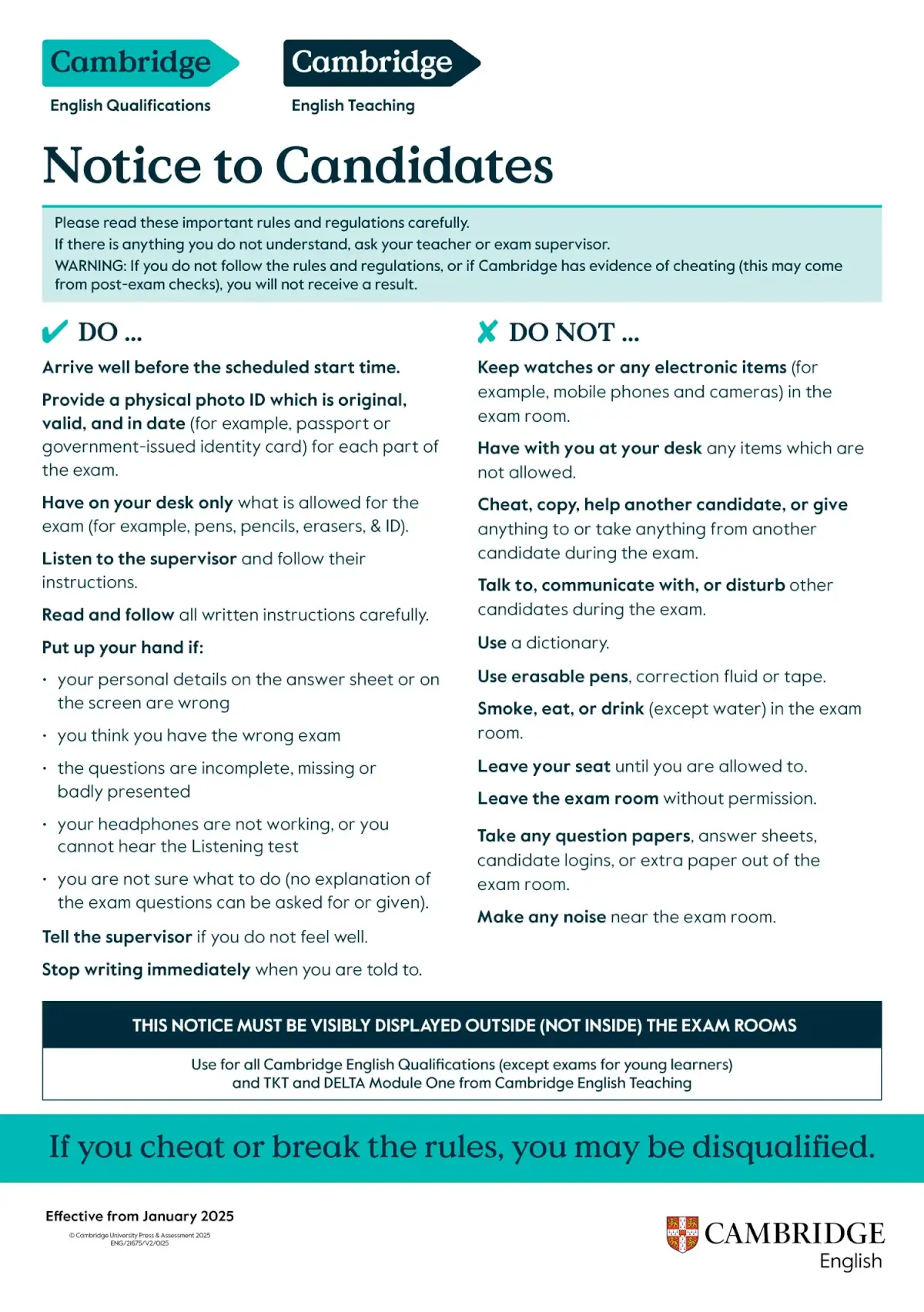
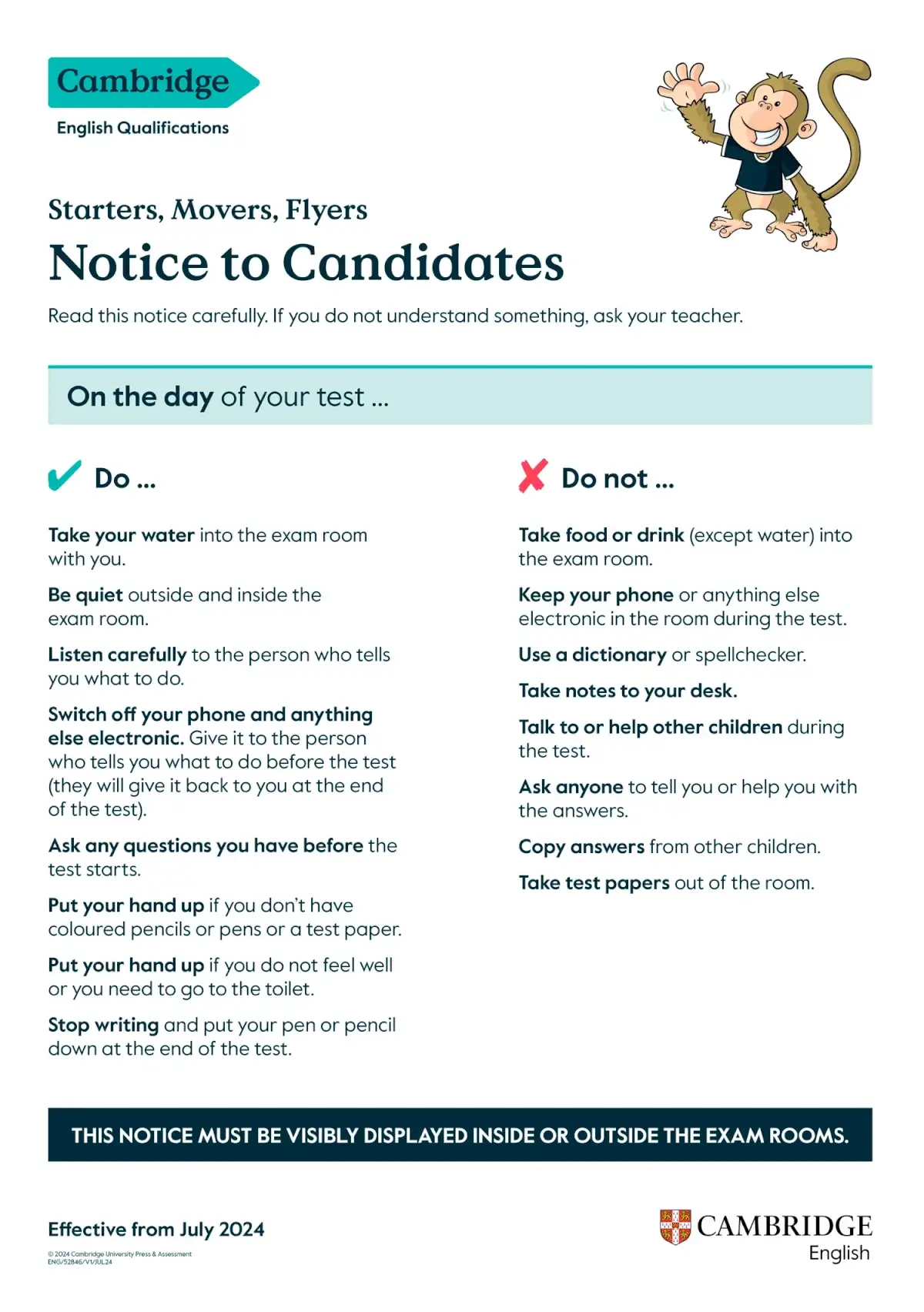
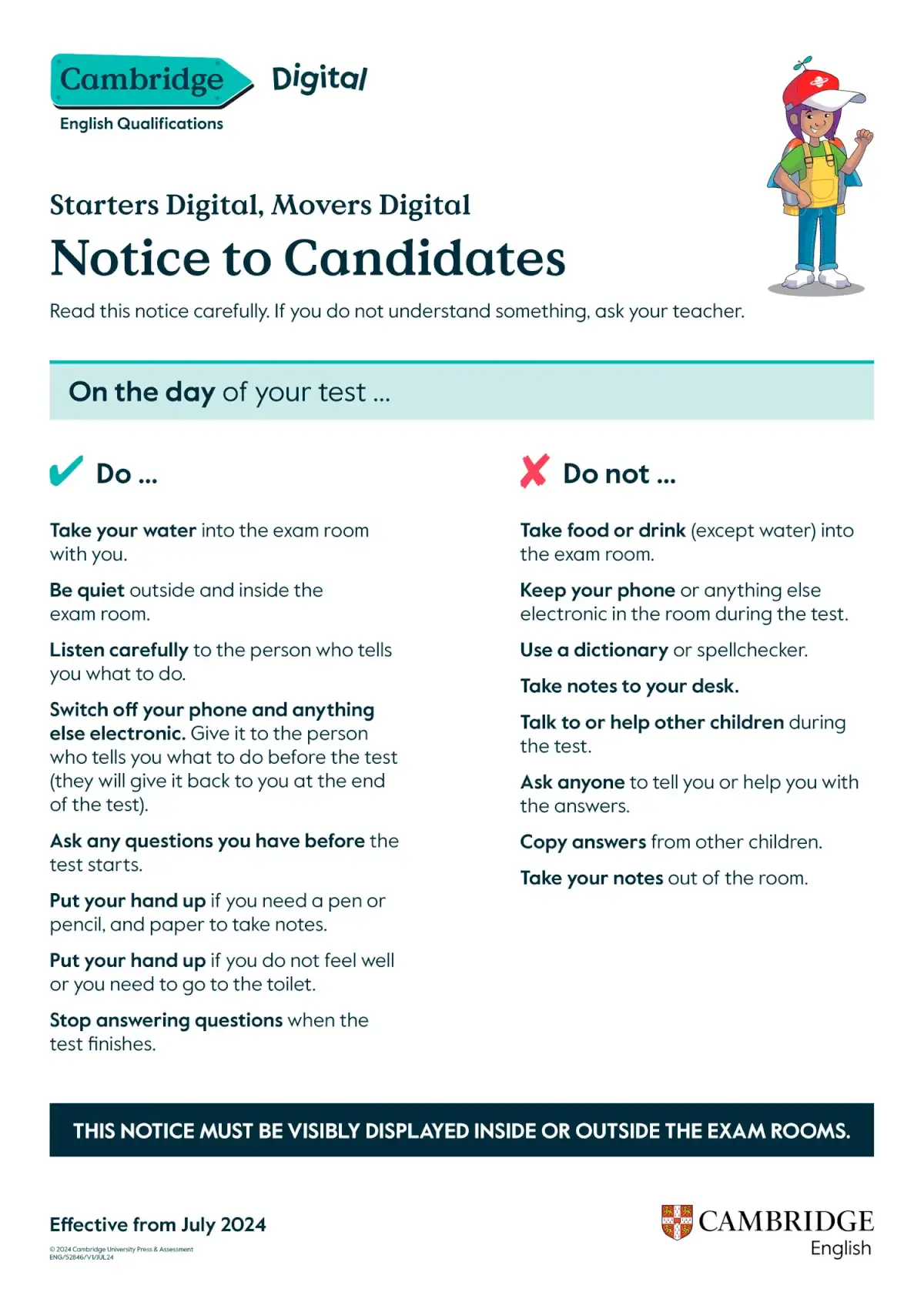
It is the Centre’s responsibility to ensure that all candidates are provided with the current Notice to Candidates and Summary Regulations for Candidates at the time of registration.
Cambridge English reserves the right to modify its Regulations, as required and from time to time.
If any of these regulations and conditions are deemed invalid or unenforceable, that will not affect the validity and enforceability of any remaining regulations and conditions.
Definitions
- Cambridge English: an exam board and part of Cambridge University Press & Assessment. Experts in English language assessment, responsible for creating, distributing, and marking Cambridge English exams.
- Centre: a Cambridge English Authorised Exam Centre. Centres are independent institutions; they are not directly controlled by Cambridge English and Cambridge English is not liable for actions or omissions by Centres. By registering for a Cambridge English exam, schools, and candidates enter a contractual relationship with their Centre.
- Candidate: an individual who has registered with a Centre to take an exam.
General regulations and conditions
1 Registering for an exam
1.1 Cambridge English exams may be taken by an individual of any age, gender, race, nationality, religion, etc. Although they are designed for speakers of other languages, no language restrictions apply.
1.2 Candidates can take exams as often as they wish (but only once per exam administration), subject to the exam dates set by Cambridge English and scheduled by Centres. Candidates can take different exams in the same week, for example, B2 First and C1 Advanced.
1.3 Candidates must take all components of an exam on the dates specified and it is not possible to take some components in one session and the rest in another session.
1.4 Cambridge English exams have no age limits, but the following exams are designed for school-aged learners:
- Pre A1 Starters
- A1 Movers
- A2 Flyers
- A2 Key for Schools
- B1 Preliminary for Schools
- B2 First for Schools
See cambridgeenglish.org under the relevant exams for details.
1.5 Teaching Knowledge Test (TKT) is a modular exam. Candidates can take any combination of the modules, subject to the exam date offered by the Centre.
1.6 Attempts to breach the registration regulations may result in Cambridge English cancelling the entry without any refund of fees and/or the candidate’s result being withheld temporarily during investigation, and permanently if entry regulations have been breached.
1.7 Registrations for the exams are submitted through a Centre. The Centre will give schools or candidates exam details such as the exam dates, registration closing dates, and exam fees.
1.8 Centres charge fees for Cambridge English exams for each registered candidate. Fees may vary depending on local costs.
1.9 Where Cambridge English permits a school to use its branding, this is not authorisation to act on behalf of Cambridge English but only in connection with the licensing of Cambridge English exams and subject to specific approval and regulations regarding such licensing and branding.
1.10 Centres decide which exams they offer on which date. They may refuse a registration if they are not running that exam, or they have already reached their capacity.
1.11 Cambridge English has some arrangements for candidates with access requirements (e.g., extra time or modified papers) and the Centre will apply approved arrangements on the exam day. Enquiries about these arrangements must be made through Centres as soon as possible, to enable them to prepare and to meet the specific deadlines.
1.12 Late registrations (made after the deadlines) may incur an extra fee. Acceptance of late registrations will depend on Cambridge English's policy and the Centre’s policy.
1.13 Registrations can be transferred to another date before the registration deadline and if the Centre is offering an alternative date.
1.14 When a candidate cannot attend the exam, the Centre may make a full or partial refund or register the candidate for a different date. If the Centre considers that the reason given is justified on compassionate/medical grounds, or because the circumstances were outside of the candidate’s control, they may withdraw the candidate. The Centre may ask for supporting evidence such as a medical statement. When an entry is withdrawn, no result will be issued. Candidates should check with their Centre for any refund policies and deadlines.
1.15 Centres in Africa, Asia, and Australasia must record the ID number when a candidate registers for C1 Advanced. This ID number must be entered into Cambridge English’s exam entry system by the deadline.
1.16 The candidate must inform their Centre at the time of registration if they intend to use the exam for immigration purposes and provide the ID number from an ID that the relevant immigration authority will accept. The candidate must present the same ID on the exam day.
1.17 Candidates must check if they have suitable ID and if they do not have suitable ID, they must inform the Centre before registering for an exam. For candidates aged 17 or under without suitable ID, the Centre will provide a Candidate ID form which must be completed before the exam day.
1.18 Administering Cambridge English Qualifications Digital requires access to the internet, a power supply, equipment, etc. that Cambridge English does not own, control, or assume responsibility for. When registering for an exam, the candidate or their parent/guardian understands that Cambridge English will not be responsible or liable, directly or indirectly, for any damage or loss caused or alleged to be caused by or in connection with the use of or reliance on any such access, equipment, or services.
1.19 Cambridge English believes all people should be treated with dignity and respect. For more information, refer to the Cambridge English Safeguarding policy.
2 Photo ID
2.1 Each candidate, unless they are taking Pre A1 Starters, Pre A1 Starters Digital, A1 Movers, A1 Movers Digital, or A2 Flyers, must bring an acceptable photo ID on the exam day. The ID must include a photo, the candidate’s full name and date of birth. The ID must be original and unexpired. Candidates aged 18 or over must use one of the following:
- a passport
- an identity document issued by the government of the country where the exam is held and officially recognised as proof of identity, such as a driving licence or residence permit.
- government-issued National ID issued in an EU or Schengen area country being used in another EU or Schengen area country.
The authenticity of a physical ID may be verified, alongside visual checks, using methods, such as ultraviolet light or ID scanning devices and applications.
Digital ID may be acceptable if it is government-issued and recognised as official proof of identity in the country where the exam is taking place. The Centre must also be able to verify it on and throughout the exam day using the official verification service. Candidates intending to use digital ID must check before the exam day that their Centre can accept and/or verify the ID.
Candidates, regardless of their age, taking the exam in Africa, Asia, or Australasia must not present a foreign ID unless it is a passport.
A candidate intending to take the exam for immigration purposes is responsible for registering with an ID that the relevant immigration authority accepts and for presenting the same ID on the exam day.
Candidates must inform the test centre of any changes to their ID document before the exam day. Candidates who bring a different ID to the one they registered with, may not be allowed to take the exam and may not be eligible for a refund or transfer.
Candidates aged 17 or under must use either an acceptable ID listed above or one of the following:
- school / college physical ID (provided their Centre accepts it as proof of ID)
- Candidate ID form (downloaded from the support site and completed before the exam).
Candidates taking C1 Advanced in Africa, Asia, or Australasia must present the same ID on the exam day as the one used at registration, otherwise the Centre may not allow them to take the exam or Cambridge English may not issue a result, and they may not be eligible for a refund.
2.2 The candidate's ID number will be checked and saved by the Centre on the exam day. That number will be included with the result on the Results Verification Service. Once the ID number has been uploaded, any amendments need to be verified by Cambridge English. If the ID number is incorrect and verification is not possible, Cambridge will remove the ID number.
2.3 If a candidate does not bring their ID on the exam day, the Centre may not allow them to take the exam, or they may not receive a result.
2.4 Verification of identity may also include biometric checks such as finger/thumb printing, reading of biometric data stored on identity documents, and voice identification. Other verification measures may include signature/handwriting comparison, photo/video recording, and other forms of electronic confirmation. Centre staff and, occasionally, Cambridge English representatives verify identity.
2.5 Only the person registered for the exam can take the exam. If Centre staff cannot confidently verify the identity of the candidate, they must not allow the candidate to take the exam. Occasionally, when there are doubts over a candidate’s identity, a candidate may be required to provide further proof of ID either on or after the exam day, such as presenting another ID and/or providing a copy of their ID to their Centre and/or Cambridge English. If Cambridge English is not confident in the identity of the candidate, they will withhold or cancel the result.
3 Electronic items
3.1 Candidates must not keep watches (all types) or any electronic items, such as mobile phones, recording devices, audio/video players, etc. in the exam room during the exam. Keeping unauthorised items in the exam room will be considered malpractice.
3.2 Centres or Cambridge English representatives may use electronic detection scanning devices such as hand-held metal detectors/wands.
4.1 Test day photos are mandatory for B2 First, C1 Advanced, and C2 Proficiency exams and are one way to check identity on exam day and in the future. By registering for these exams, a candidate, or their parent/guardian, understands that a test day photo will be taken. The list of exams with mandatory test day photo is subject to change and Centres will notify candidates about procedures.
4.2 If a candidate, or their parent/guardian, declines a mandatory test day photo, the candidate may not be allowed to take the exam. In cases where the exam is taken without a photo, Cambridge English reserves the right to withhold or cancel the result. Candidates who decline a photo may find that their options for using the result may be limited because there is no photo on the Results Verification Service .
4.3 The photo, whether mandatory or not, will be added to the Results Verification Service cambridgeenglish.org/verifiers and may be added to the Statement of Results. Candidates decide who can access it via the Results Verification Service by sharing their result via Results Service for Candidates or by sharing their Verification Number with their chosen institution.
4.4 Cambridge English may also use the photo and passport/ID number for malpractice checks.
4.5 If the candidate wants to use their result for immigration purposes, they must remind their Centre when the test day photo is taken. The Centre must check that there is an ID number that will be recorded against the test day photo and that it matches the ID presented by the candidate.
4.6 Cambridge English will not usually issue a result for a C1 Advanced candidate if an acceptable test day photo is not taken and uploaded into the appropriate Cambridge English system. If the candidate’s photo is uploaded after the deadline, their result may be delayed.
Download the PDF document here
Notice to Candidates posters